
How to Search Criminal Dockets
Begin with Kansas CaseSearch, the state's official public portal. Pick District, then choose Case Number or Party Name and type the full search term. Narrow the county to Barber and select Criminal if the case-type filter helps. After the human check, submit. Compare the court, filing date, type, and case number before opening a result.
- Copy the exact case number or party spelling from a court paper.
- Choose District and Barber County in the portal.
- Use the full four-digit year in a current case-number search.
- Open the match and read the newest public event.
- Contact the clerk if the result or document is not available.
Kansas Courts eFlex serves authorized electronic filing only. It is not a public docket search. Note also that a file-date range narrows filing dates, not hearing dates.
CaseSearch Fields for Barber County Criminal Dockets
The portal keeps route fields separate from the search term. Each control narrows eligible public information without changing a record's legal access status.
| Field | Use |
|---|---|
| Court | District for the county case; Appellate for an appeal. |
| Search Type | Case Number or Party Name, with business and citation options also offered. |
| County | Barber County, identified by acronym BA. |
| Case Type | Criminal narrows the district results. |
| Dates | Optional filing-date filters. |
What a Criminal Docket Shows
Kansas Supreme Court Rule 22 calls the public chronological list an events index. Most readers just call it the docket sheet. Remember, a public entry is a navigation point, not always the underlying document.
| Header | Case number, file date, court, type, judge, and public status. |
|---|---|
| Parties | The State and defendant roles, with public attorney details where shown. |
| Charges | Allegations and classifications that must be read apart from the outcome. |
| Events | Filings, pleas, motions, orders, settings, resets, judgment, and appeal activity. |
| Documents | Eligible linked papers; some restricted or older papers will not appear online. |
A Barber County Criminal Docket Entry Is Not a Conviction
A charge or complaint is an allegation, nothing more. A motion is a request, not a ruling. A plea event marks a formal stage, yet it is not automatically the final judgment. Read the charge block, plea history, disposition, and signed order as separate parts of the Barber County criminal docket.
Kansas statistics sort outcomes into categories like deferred adjudication or diversion, dismissal, guilty plea, other, jury trial, and court trial. For any single case, the actual entry and judgment control the meaning. A portal screen is not a clerk-certified judgment.
Stages on a Criminal Docket
Cases rarely follow one fixed sequence, but major procedural steps usually create separate events. Watch for later orders that reset a date or resolve only part of the case.
Early entries often cover appearance, counsel, or bond. Pretrial entries may add motions, responses, conferences, and orders, while sentencing, costs, restitution, appeal, or enforcement can bring activity after the main disposition.
FY2025 Barber County Criminal Docket Context
Official Kansas reports for the fiscal year ending June 30, 2025, recorded 25 felony filings and 37 misdemeanor filings in Barber County. That totals 62 criminal filings. Separate tables recorded 22 felony dispositions and 27 misdemeanor dispositions.
These are counts of court activity, not people. Filing and disposition totals also measure different events, so they give local scale but cannot replace an individual docket and judgment.
Which Court Holds Criminal Dockets
Felonies and state district misdemeanors route through Barber County District Court in the 30th Judicial District. The Magistrate Division works inside that structure. Kansas has no separate justice of the peace or county court layer for these records.
A city ordinance case belongs with the municipal court named on its citation. Medicine Lodge, Kiowa, and Hardtner run their own city-court routes. Sharon and Hazelton city offices handle local routing but post no current public search. Federal criminal cases go through District of Kansas PACER and CM/ECF, not Kansas CaseSearch.
The Clerk Route for a Barber County Criminal Docket
Tina McCray, Chief Clerk of the District Court, is the local contact. The office sits at 118 E. Washington, Medicine Lodge, KS 67104. The phone is 620-886-5639. Court Services can be reached at 620-886-3021. Published hours are Monday through Friday. They run 8:00 to noon and 1:00 to 4:00.
Prepare a focused request
Give the court name, full case number, date range, exact event or document, and whether a plain or certified copy is needed.
Confirm any mail, fax, email, or drop-box method before using it. The office posts no complete current copy-fee schedule. Ask for the price and payment method rather than sending an assumed fee.
Barber County Criminal Docket Events and Documents
A visible event does not guarantee a web image of the complaint, affidavit, warrant, exhibit, report, or order. Each document has its own access status. The 30th Judicial District entered Kansas eCourt on September 12, 2022. An older converted document may therefore require the courthouse terminal or the clerk. A terminal can expose eligible public material not remotely available, but it cannot override a seal. The Kansas Court Records Request Form is the documented written route for a specific KORA request.
Before making that request, separate the product you need from the general idea of a case file. A docket sheet or events index lists activity. A complaint states the filed allegation. A journal entry or judgment records court action. A transcript is a separate record of proceedings. Asking for the exact item, event date, and case number helps the clerk decide whether it is public. It also shows where it can be reviewed and whether a copy or certification fee applies.
Probable-cause material, presentence reports, unexecuted warrant material, and other protected papers can follow rules different from the public case header. One missing attachment does not seal the whole Barber County criminal docket. The sound next step is asking whether a specific document is restricted, simply not remote, or part of an older converted file. That distinction keeps a technology limit from being mistaken for a legal access limit.
Reading Barber County Criminal Docket Dispositions
Match every entry to the right charge and the signed order behind it. A dismissal only makes sense with context. Read the case entry or order explaining its reason and scope. For a guilty plea, pull the judgment. That is where the case-specific terms live. Deferred adjudication or diversion works the same way: the docket label is just a label, and the actual order controls its effect.
- Motion
- A request, not proof it was granted.
- Order
- The court's direction or ruling.
- Disposition
- The recorded way a case or charge ended.
- Certified copy
- A clerk-authenticated record, unlike a portal view.
Missing Barber County Criminal Docket Results
A blank screen after a docket search has several common causes. Spelling errors and incomplete case numbers trip people up constantly. Restricted case types and pre-eCourt records produce the same empty result. So do sealed files and plain technical glitches. Verify the court first. Retype the exact number. Then select Barber County and Criminal, and call the clerk if nothing appears.
Some material is legally off limits or partially hidden. Expunged cases, grand-jury matters, and juvenile cases may be absent. So may unexecuted warrants, search-warrant material, and presentence reports. An empty result proves nothing either way. It is not evidence that no case exists or that some outcome occurred.
Jurisdiction matters too. A city citation may stay with the municipal court named on the paper. A federal prosecution belongs to the District of Kansas system, not this one. When an older case number fails, copy its format exactly. Do not force it into a current pattern. Those routing checks often explain a fruitless Barber County criminal docket search. They say nothing about the person or the case.
Public Access and Sealed Criminal Dockets
Under Rule 22, the public portal and a courthouse terminal both open eligible case records and events indices, as long as statutes and court orders allow it. KORA gives requesters a framework. It does not turn every criminal paper into a public record.
Access boundary: A public terminal is an alternate source for public material, not a way around a seal or nonpublic classification.
K.S.A. 45-218 governs inspection and how fast an agency must respond. Its third-business-day deadline covers a response or a denial, though, not guaranteed completion of a complicated production.
Verify a Barber County Criminal Docket Outcome
Start in the portal. Identify the case and follow its public history there. When a paper is not linked, ask the clerk whether it is public at the courthouse terminal or available on request. For real proof of an outcome, request the final judgment or journal entry. Say whether you need it certified. The official current CaseSearch interface displays the controls that route a search to the right court.
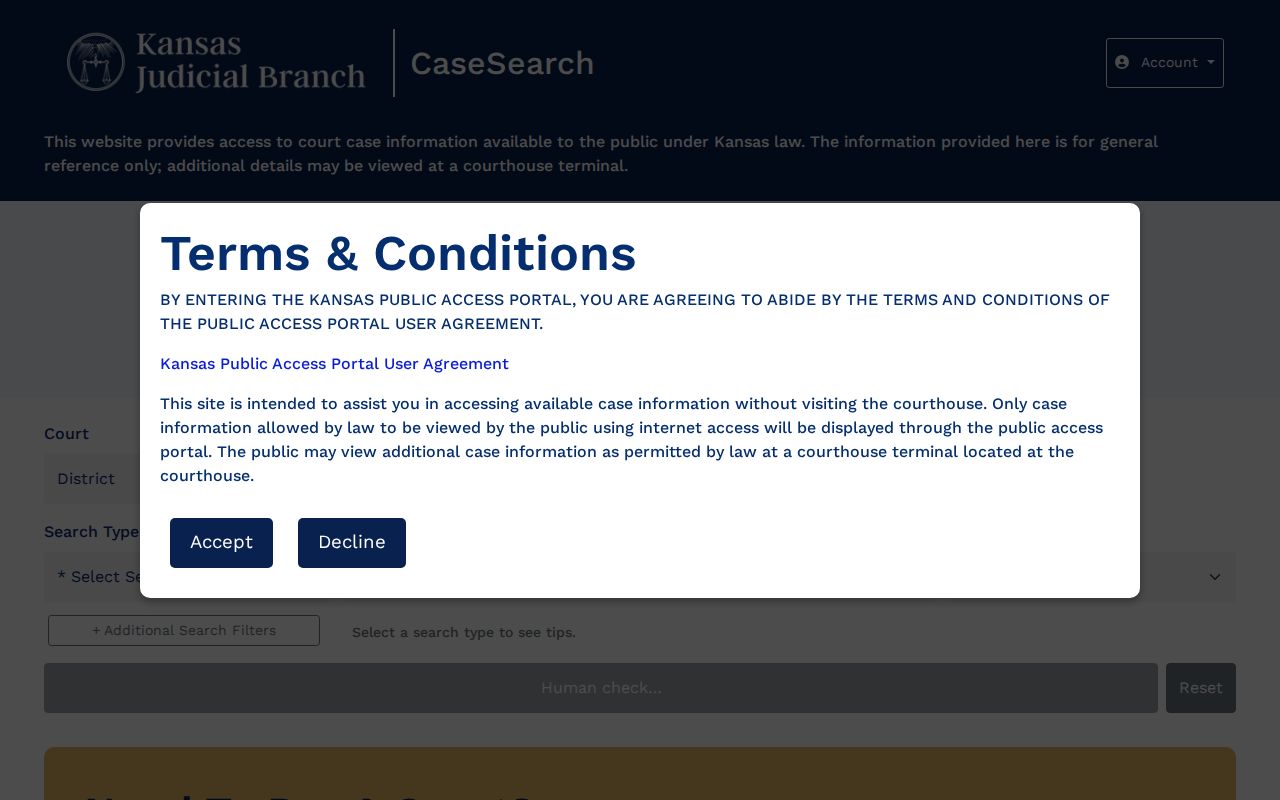
Choose the Barber County and Criminal filters to narrow the results, and finish the human check before you submit.
Confirming Settings on Barber County Criminal Dockets
Never trust a hearing date buried in an older docket event. Continuances, resets, cancellations, later orders, and calendar changes can all follow it. The initial CaseSearch form also lacks any stand-alone hearing-date search. Open the case detail instead. Read the events in date order and compare the newest notice or order. Missing details matter too. If the detail omits the time, courtroom, judge, or setting type, do not act on the date. Then call the Clerk of the District Court. Court Services can help too.
The 30th Judicial District's official court-days PDF helps decode recurring labels like CR. It dates from 2022, though. It is no one's live calendar. A current notice plus confirmation from the court always carries more weight. Keep the case number handy. Ask about the precise setting. Write down whom you contacted and when. That habit keeps a general schedule from being mistaken for the controlling order in a Barber County criminal docket.